
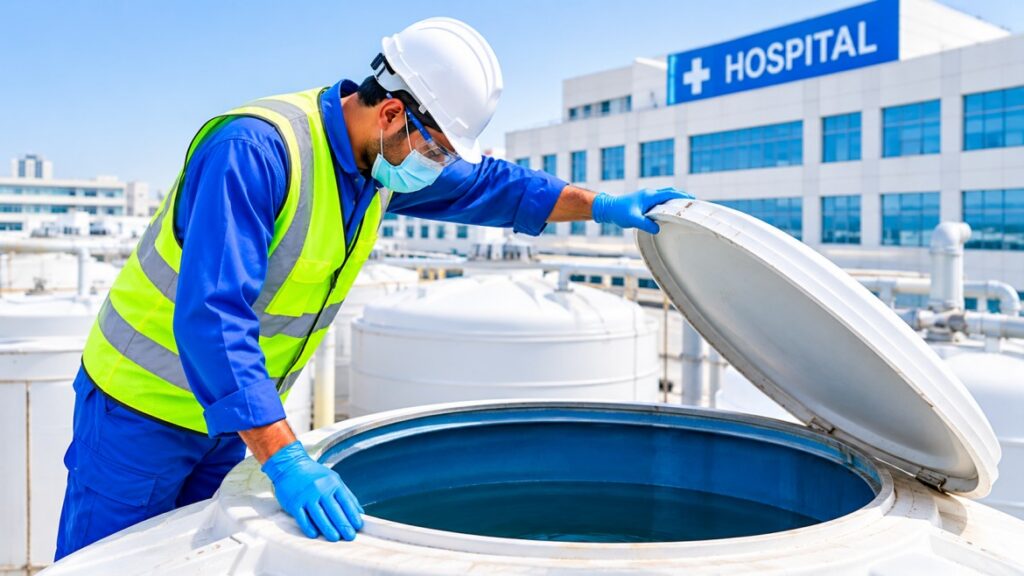
Every hospital has an unseen water supply: the tanks on the roof, under the car park or in the plant room that feed every tap, shower, kitchen and cleaning station in the building. When those tanks are clean, nobody notices. When they are not, the people most at risk are the ones the hospital exists to protect.
Hospital water tank cleaning in Abu Dhabi is both a legal obligation and a core infection-control measure. This guide explains what the rules require, what a proper clean involves, how it connects to Legionella control and how to choose a contractor you can defend in an audit.
Why Hospital Water Tank Hygiene Is a Patient Safety Issue
A hospital never stops using water. Stored water supplies handwashing stations, patient bathrooms, showers, kitchens, laundry, housekeeping and staff facilities, around the clock and across every department.
Patients with weakened immune systems, such as those in intensive care, oncology or post-surgical recovery, are the least able to cope with contaminated water. That is why a dirty tank matters more in a hospital than in almost any other building.
There is a second point that is easy to miss. Water can reach your building in good condition and then be spoiled by the tank it is stored in. What happens inside the tank decides what comes out of the tap.
And you cannot judge it by looking. Clear, odorless water is not proof of safety. Only laboratory testing can confirm it.
What Goes Wrong Inside a Neglected Tank
Most tank problems build up slowly and out of sight:
- Sediment and sludge: dust and particles settle at the base and degrade water quality over time. Disturbed during refilling or high demand, they reach the outlets.
- Biofilm: a slimy layer of microorganisms that grows on wet surfaces. It shelters bacteria, and simple rinsing does not remove it.
- Stagnation: water that sits unused encourages microbial growth, especially in large, multi-department buildings with uneven demand.
- Damaged covers and vents: cracks and loose lids let in dust, insects and other contaminants.
- Corrosion: rust and failing internal coatings shorten tank life and affect water cleanliness.
- Warm, slow-moving water: in a hot climate, stored water that turns over slowly can warm into the range where bacteria multiply fastest (more on this in the Legionella section).
Abu Dhabi Requirements and Cleaning Schedule
Under Abu Dhabi’s public health rules, drinking water tanks in buildings across the emirate must be cleaned and disinfected at least once every six months.
Only companies licensed by the Department of Municipalities and Transport (DMT) are authorised to carry out the work. A general cleaning company does not qualify. DMT’s requirements for licensed tank cleaning companies refer to Decision No. 26 of 2018 on the general health and safety of drinking water tanks in the Emirate of Abu Dhabi.
Healthcare facilities should also confirm any additional requirements with the Department of Health – Abu Dhabi. Rules can change, so verify the current position with both authorities before you finalise your schedule.
The six-month cycle is a minimum. Clean sooner when the situation calls for it:
Situation | Recommended action |
Routine cycle | Clean and disinfect at least every six months |
Inspection finds damage, sludge or contamination | Clean and disinfect sooner, and repair the defect |
Repairs or a contamination incident | Clean, disinfect and verify with laboratory testing |
Reports of odour, taste or cloudiness | Investigate and clean promptly |
The Hospital Water Tank Cleaning Process, Step by Step
Cleaning a tank in a live hospital is a managed operation, not a quick wash. Every step has to protect the water supply, the staff doing the work and the patients downstream.
- Site survey and tank inspection. Record tank size, material and internal condition. Check covers, vents, inlet, outlet and overflow, and note any damage that needs repair.
- Planning around patient care. Agree timing with facility management and arrange a temporary water supply so essential departments stay supplied. Good practice is to involve the infection control team and to phase the work when a building has several tanks.
- Isolation, drainage and safe entry. Isolate the tank, drain it and set up safe confined-space entry with trained staff and proper chemical handling.
- Sludge removal and interior cleaning. Remove sediment and deposits, paying particular attention to corners and joints. Use methods and materials suited to the tank so the lining is not damaged.
- Disinfection. Cleaning removes dirt; disinfection reduces microorganisms. Disinfectant type, concentration and contact time must follow approved technical requirements.
- Flushing and refilling. Rinse thoroughly and return the tank to service only after every procedure is complete.
- Laboratory testing, reporting and handover. Samples go to an accredited laboratory, and you receive a report covering inspection findings, work done and test results.
Water Testing After Cleaning: What and Why
Cleaning and disinfection reduce risk, and testing proves the result. Without a laboratory report, you are relying on appearance alone.
Good practice for post-cleaning testing:
- Samples are taken by competent personnel at agreed points
- Analysis is carried out by an accredited laboratory
- The scope typically covers microbiological quality and relevant chemical parameters, agreed with your infection control and water safety team
- Results are recorded and reviewed, not just filed
- Unsatisfactory results trigger re-cleaning, disinfection and retesting
Tank Cleaning and Legionella Control
Legionella bacteria can grow in building water systems and spread through contaminated droplets and aerosols. Widely used UK Health and Safety Executive (HSE) guidance notes that they multiply between roughly 20°C and 45°C when nutrients are present, and recommends storing cold water below 20°C.
In a warm climate like Abu Dhabi’s, stored cold water can drift into that range easily, which makes tank condition, covers, insulation and turnover important. Sediment, scale and biofilm also give bacteria nutrients and shelter, which is why tank cleaning is part of control.
Tank cleaning removes the habitat. A complete hospital water safety programme stops it returning:
- Keep tanks covered, closed and accessible for inspection
- Avoid stagnation: HSE guidance suggests stored water should turn over at least every 24 hours
- Monitor and record stored water temperatures
- Flush rarely used outlets
- Remove unused pipe sections (dead legs) where possible
- Carry out microbiological testing as your risk assessment directs
- Keep a documented risk assessment and review it regularly
Which standards your facility follows is a decision for your infection control and water safety team. Choose a contractor whose reports feed straight into that programme.
How to Choose a Hospital Water Tank Cleaning Company in Abu Dhabi
The lowest quote should never decide who works on your water supply. Verify the following before you appoint anyone.
Criterion | What to verify |
Licensing | Valid DMT license for drinking water tank cleaning |
Technical method | Disinfectant type, concentration, contact time and flushing procedure |
Laboratory testing | Accredited laboratory, defined sampling and clear reporting |
Documentation | Inspection findings, test results and service records suitable for audit |
Health and safety | Staff training in chemical handling, hygiene and confined-space entry |
Operational planning | Scheduling and temporary water supply agreed with facility management |
Continuity | Annual Maintenance Contract with scheduled visits and service reminders |
Questions to ask on the first call:
- Can you show your current DMT license?
- What is your disinfection procedure, including concentration and contact time?
- Which laboratory tests the water, and what do the results cover?
- How will you keep critical departments supplied during the work?
- What documents will we receive when the job is complete?
7 Common Mistakes Hospitals Make
- Treating clear water as safe water. Only laboratory testing confirms safety.
- Hiring an unlicensed contractor. Only DMT-licensed companies may clean drinking water tanks.
- Skipping laboratory testing. A clean tank without a test result is an unverified one.
- Cleaning without a temporary supply plan. This risks disrupting patient care.
- Ignoring covers, vents and inlets. A freshly cleaned tank can be recontaminated through damaged fittings.
- Cleaning only after a complaint. The six-month cycle exists to prevent problems, not respond to them.
- Keeping incomplete records. If it is not documented, it did not happen as far as an inspector is concerned.
Why Hospitals Choose a Water Tank Cleaning AMC
A one-time clean solves today’s problem. An Annual Maintenance Contract (AMC) keeps you compliant all year and typically includes:
- Scheduled inspections and cleaning visits
- Disinfection and water sampling
- Defect identification with corrective recommendations
- Service reminders and complete documentation
For a facility manager, that means no missed deadlines, a consistent audit trail and one less compliance item to chase.
Facilities That Need Professional Water Tank Cleaning
Private and multi-specialty hospitals, government healthcare facilities, medical centres and clinics, dental clinics, diagnostic laboratories, rehabilitation and day surgery centres, and healthcare staff accommodation.
Book Professional Hospital Water Tank Cleaning in Abu Dhabi
Don’t wait for a complaint, a sludge finding or a failed inspection. Make planned tank maintenance part of your hospital’s preventive programme.
New Blue Diamond Contracting and General Maintenance LLC
Book your site inspection: +971 56 412 8476
We also provide pest control, AC duct cleaning, deep cleaning and grease trap cleaning for commercial properties.
Frequently Asked Questions (FAQs)
How often should hospital water tanks be cleaned in Abu Dhabi?
At least every six months, by a DMT-licensed company. Clean sooner after damage, contamination or poor test results.
Is hospital water tank cleaning mandatory in Abu Dhabi?
Yes. Drinking water tanks in Abu Dhabi buildings must be cleaned and disinfected regularly, and only licensed companies may do the work.
Who is allowed to clean water tanks in Abu Dhabi?
Only companies licensed by the Department of Municipalities and Transport (DMT).
Can a dirty water tank affect patient safety?
Yes. A poorly maintained tank can become a source of contamination, and hospital patients are more vulnerable than most.
Does tank cleaning alone prevent Legionella?
No. You also need risk assessment, temperature management, flushing of rarely used outlets and microbiological testing.
Should water be tested after cleaning?
Yes. Testing by an accredited laboratory confirms that the water is safe to use.
Will tank cleaning disrupt hospital operations?
Not when it is planned properly. Timing and a temporary water supply are agreed with facility management before work begins.